





















School spending: Everything education suppliers need to know

This blog post is written for education suppliers looking to better understand school spending.
To sell to teachers and education staff successfully, you need to understand the ins and outs of school spending and the factors that influence how schools make purchasing decisions.
By knowing what’s going on behind the scenes and the various purchasing mechanisms at play, you can adapt your strategy to one that better aligns with how schools actually work and as a result, increase your odds of winning business. Here’s what you need to know about school spending…
1) How school budgets are allocated & why they can change
Schools set and plan out their budgets every year but how they actually use them can change. Unexpected circumstances can cause schools to re-prioritise where they invest. For example, if a school experiences high teacher absence rates due to sickness, they may need to temporarily bring in supply staff, a last-minute investment that can impact how much they can spend in other areas.
These unforeseen circumstances can cause schools to pause planned investments, so when schools say ‘no’, it often means ‘not yet’, as opposed to ‘no budget’.
Just like businesses, schools have to prioritise certain areas for spend like staffing and fixed costs. Although these areas take up big chunks of their budgets, they do still have money to spend with suppliers for education products and services. We recommend increasing your brand awareness over time with long-term marketing campaigns. This will help you to plant the seed of how you can support teachers, so that when they’re ready and able to invest, they do.
2) What specific funding pots are available
There are a number of specific pots and ring-fenced funding schools can access like the PE and sport premium. By knowing what pots are available, and importantly, the ones relevant to your offering, you can tailor your marketing messaging around them so that schools know that they can access the funding to invest in your services.
There are also often grants available to improve particular areas of education, for example, WiFi connectivity in schools. To stay up-to-date and never miss a relevant opportunity to support schools, we recommend signing up to the Department for Education email updates. You’ll get notifications on education news and new funding pots that you can build into your marketing strategy.
Schools receive and can access a wide range of government funding. They can also generate their own income, for example, by letting out their sports hall for community exercise classes.

Here’s a list of some of the income and funding schools can get:
- Government grants
- High needs funding
- Early years funding
- Universal infant free school meals
- Self-generated income
- PTA contributions
3) Which education staff are involved in school spending decisions
School spending decisions are made by a chain of education staff, not just one person. There are influencers and decision-makers; influencers are your end-users like teachers and support staff, and decision-makers are the ones who have the final say e.g. head teachers.
Naturally, if the investment requires a larger spend, more staff will be involved. If it’s a low-cost investment, teachers can usually make the decision to spend without approval from other staff.

Make sure your marketing mailing lists include the relevant influencers and decision makers. For example, you might want to include subject leads (like Heads of Science), school business managers, the senior leadership team, and other relevant staff. You can find out more about school spending influencers here, school spending decision makers here, and the full list of job roles here.
4) Why schools sometimes don’t buy even when they’re interested
Education priorities can shift quickly which means schools can’t always invest straight away. For example, following an Ofsted inspection, a school may need to invest in one specific area like attendance and behaviour, and as a result, temporarily pause spend in other areas.
Sometimes it’s just a case of ‘right supplier, wrong time’. That’s why you need to continuously build your brand awareness and maintain visibility so that when teachers are ready to invest, they do.
Teachers don’t always align on what to invest in, particularly if managing multiple priority focuses. They might also not have budget visibility and therefore need to delay investing until they receive confirmation from senior members of staff. Purchasing delays can also be caused by procurement rules schools need to follow. This is often the case in MATs as larger trusts may require quotes, tenders or frameworks to follow.
Another key reason why schools don’t buy comes down to the fear of making the wrong decision. Schools are risk-averse which means they invest carefully. If they’re not convinced an education supplier will deliver on the proposed outcomes, they won’t spend.
5) How to win more work with schools
To generate more leads in schools and secure more business, align your marketing around the key school spending windows.

According to our School Survey last year, 47% of education staff respondents said they spend regularly throughout the year, 24% said they spend mainly between September and December and 23% said they focus their spending between April and June. To maximise your chances of reaching schools when they’re spending, we recommend creating a year-round education marketing strategy.
Secondly, make your education offer easy to justify internally. In your marketing campaigns, always outline the benefits to teachers clearly, tell them what problem you’ll help them solve, sell the outcomes not the features, and include powerful teacher testimonials from schools you’ve worked with. Social proof is essential for marketing success – it gives teachers confidence that they can invest in you and that you’ll deliver.
Where possible, reduce any barriers to teachers buying. For example, include clear information, clear pricing, simple delivery processes, and a sales process that involves minimal admin.
School spending: Short summary
Most education suppliers focus on what they’re selling but the ones who win understand how schools buy. When building your education marketing strategy, remember:
- Purchasing delays can be caused by internal school decisions and changing priorities
- Schools avoid risk and seek confidence – you need to show why your offering is worth investing in. The easiest-to-justify option often wins.
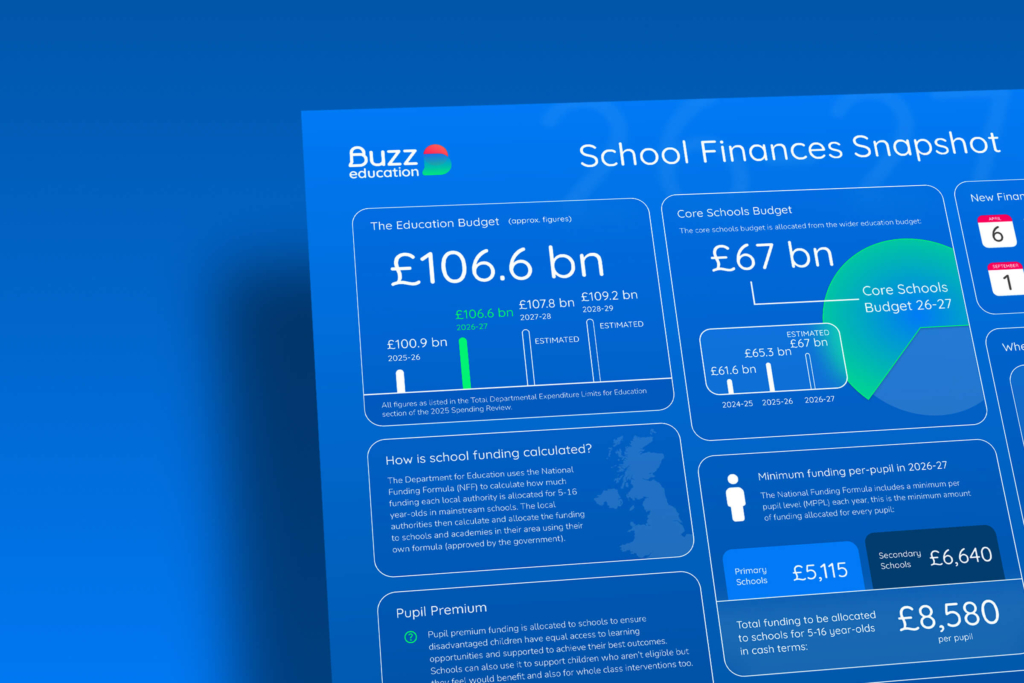
Want to understand the data behind school budgets?
Check out our school finances infographic where we breakdown the education budget, per-pupil funding, and more!

STRATEGY CALL
Need support with your education marketing?
Access free education marketing support from our resident expert, Michael, who can help you build an effective marketing strategy tailored to how schools spend.